If you're evaluating an ERP system in 2026, the Odoo vs SAP question comes up almost inevitably. Both platforms can run a business end-to-end, but they were built for different worlds — and pretending otherwise does not help anyone make a good decision.
We are an Odoo implementation partner, so we clearly have a preference. But preference is not the same thing as honesty. SAP is the global market leader for a reason, and there are real scenarios where it is the better choice. This article explains where each platform wins, where each one falls short, and how to determine which side of that line your business is on.
In Short — Who Should Choose What
Choose Odoo if you are a small or medium-sized company (typically under 500 employees), value implementation speed and total cost, want customization flexibility without enterprise-scale consulting fees, or are growing rapidly and still do not know exactly what your ERP should look like three years from now.
Choose SAP if you are a large company with complex multi-entity finances, operate in a heavily regulated industry such as pharmaceuticals where SAP has decades of built-in compliance functionality, manage global operations across many countries with complex tax and statutory requirements, or already have deep SAP infrastructure and ecosystem dependencies.
The decision becomes genuinely close when you are a mid-market company with 200–800 employees in a “normal” industry. Both platforms can do the job. The decision usually comes down to budget, internal IT capacity, and how much process standardization you want the ERP to enforce.
The Two Platforms
What Is Odoo?
Odoo is a modular open-source ERP suite launched in 2005 by a Belgian company. It comes in two editions: Odoo Community (free, open-source, licensed under LGPL-3.0) and Odoo Enterprise (commercial, with hosting options, official support, and additional features such as Studio and the multi-company app). The system is built in Python on PostgreSQL, with a modular architecture that allows companies to enable only the applications they need — accounting, sales, inventory, manufacturing, HR, eCommerce, and so on — and add more as they grow.
By 2026, Odoo reports more than 16 million users globally and over 170,000 active enterprise customers, with more than 120,000 new customers annually and approximately 20–25% CAGR growth. Revenue reached approximately €650 million in 2025 with €554 million ARR, and a recent funding round valued the company at over €7 billion. It is no longer the scrappy open-source underdog — it is a serious mid-market ERP platform with strong European roots and global reach. The Odoo platform has particularly strong adoption in France, Belgium, Spain, and increasingly in Romania and CEE markets.
What Is SAP?
SAP, founded in Germany in 1972, is the original European enterprise software company. The company offers several ERP products aimed at different segments:
SAP S/4HANA — the flagship ERP for large enterprises, built on the SAP HANA in-memory database. Available as Public Cloud, Private Cloud (typically through RISE with SAP), or on-premise.
SAP Business One — designed for small and medium-sized businesses, delivered through partners.
SAP Business ByDesign — a cloud SaaS option for mid-market companies.
SAP’s depth in regulated industries is difficult to overstate. More than 80% of the world’s top 20 pharmaceutical companies use SAP, and SAP’s pharma stack includes process manufacturing with full batch management, SAP Quality Management with integrated deviation and CAPA workflows, SAP Advanced Track and Trace for Pharmaceuticals (ATTP) for serialization, SAP Environment Health and Safety for hazardous material management, and SAP Integrated Business Planning. This is not marketing — it is the result of decades of investment in industries where compliance is non-negotiable.

Odoo ERP vs SAP Costs
Odoo Enterprise Licensing COST
Odoo uses regional pricing lists, so the exact number depends on where you are located. For European customers, the structure is simple:
One App Free — €0/user/month for unlimited users on a single app
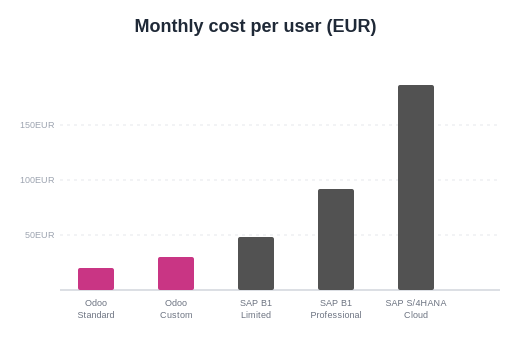
Standard Plan — approximately €19.90 per user/month, billed annually. Includes the full Odoo application suite on Odoo Online hosting (CRM, Sales, Inventory, Accounting, HR, and more).
Custom Plan — approximately €29.90 per user/month, billed annually. Adds Odoo Studio for visual customization, multi-company support, external API access, and on-premise / Odoo.sh hosting options.
With Odoo there are no per-app fees — every licensed user gets access to all standard applications for a single price. For a company with 25 users on the Custom plan, that means approximately €8,970/year in licensing. For 50 users, around €17,940/year.
Implementation costs in the European market vary depending on complexity, but for typical SME/mid-market projects: an Odoo implementation for a mid-market company with 50 users generally costs €15,000–40,000 with a 2–4 month timeline. More complex projects with significant customization, integrations, or multi-country localization can reach €50,000–200,000+ — but still remain significantly below SAP equivalents.
SAP ERP COST
SAP rarely publishes list pricing, but here is what is documented in EUR for European partner pricing:
SAP Business One (the SME product):
Starter Package (cloud, up to 5 users) — starting from €38/user/month
Limited User License (cloud) — €47/user/month
Professional User License (cloud) — €91/user/month
On-premise perpetual — €1,400 (Limited) up to €2,700 (Professional) per named user, plus annual maintenance of 19–22% of license value
For a mid-market company with 25 users using a typical mix of Professional and Limited cloud licenses, expect approximately €20,000–25,000/year in licensing alone. For 50 users, €40,000–50,000/year.
SAP S/4HANA (the enterprise product):
Cloud Essentials — approximately €185/user/month with a minimum of 15 users
Cloud Private Edition — approximately €325/user/month
On-premise — custom quote, typically an initial commitment of €900K+ plus 20–22% annual maintenance
Implementation costs are where SAP truly diverges from Odoo. An SAP Business One implementation typically costs €50,000–180,000 with a 4–9 month timeline. SAP S/4HANA implementations for mid-market companies start around €180,000 and frequently exceed €450,000. For large enterprises, implementation is usually 2–4× annual software costs.
What This Means in Practice
For a 50-user company over five years, the licensing difference alone between Odoo Enterprise (~€90K total) and SAP Business One (~€225K+ total) is substantial — more than €130K. Add implementation, and the gap widens even further. Multiple analyses estimate that Odoo is approximately 80% cheaper over 5 years than SAP for mid-market companies.
The fair caveat: TCO comparisons assume comparable scope. If you truly need SAP’s depth — say, full out-of-the-box GxP compliance for a pharmaceutical operation — the cost comparison becomes misleading because Odoo would require significant custom development to match it. We will return to this point.
A Note Specific to Romania and CEE
For Romanian companies, both platforms have local partners and Romanian localization:
Odoo has native support for e-Invoice (mandatory B2B invoicing), SAF-T reporting (D406), VAT compliance, and ANAF integration. Romania’s Odoo partner ecosystem has grown significantly over the last three years.
SAP has mature Romanian localization in both S/4HANA and Business One, with established compliance for e-Invoice, SAF-T, and Romanian tax reporting. SAP’s Romanian partner network is older and more established, but partner rates tend to be higher.
For most Romanian SMEs and mid-market companies, the localization gap that existed five years ago is no longer a major differentiator — both platforms handle Romanian compliance well when implemented by a competent local partner.
Implementation Time and Time-to-Value
ERP implementations are projects, not installations. Both platforms can fail when scope is poorly defined. But the typical timelines differ in ways that matter for growing businesses.
SAP ERP implementations are often complex and resource-intensive, taking 9–24+ months for a full deployment, with long phases including planning, workflow customization, data migration, testing, and extensive user training. SAP Business One implementations rarely go live in under 4 months, and S/4HANA projects frequently take 9–18 months.
Odoo’s modular approach typically enables shorter, phased implementations. Most small-to-medium Odoo implementations are completed within 3–6 months using agile methodology with iterative improvements, and a focused first phase (sales + invoicing + inventory, for example) can go live within 6–12 weeks.
This does not happen because Odoo is “simpler” in some absolute sense — but because the platform is designed to start narrow and expand. SAP’s strength (deep, standardized, end-to-end processes) is also what makes it slower to implement: you configure a comprehensive system before go-live, rather than enabling applications one at a time.
One statistic worth knowing: a Teradata study found that only 8% of S/4HANA migrations finish on schedule. Long timelines come with real risks.
Where SAP Truly Wins (Seriously)
We are not going to pretend Odoo is the right answer for every business. Here is where SAP is the right choice.
1. Industry-Specific Depth in Regulated Verticals
If your business is in pharmaceuticals, aerospace, automotive, oil & gas, or chemicals, SAP has industry solutions with decades of domain-specific functionality already built in. SAP S/4HANA for Pharmaceuticals includes built-in Quality Management processes, electronic batch records, detailed audit trails, and support for GxP, GMP, GLP, GCP, and FDA 21 CFR Part 11 requirements, plus full batch genealogy, serialization, RFID integration, and end-to-end track-and-trace.
Odoo can be customized to handle these workflows, but you are building rather than configuring. For a regulated pharmaceutical company, “building” means validation, documentation, and audit risk. A pharmaceutical company needing full GxP compliance will find SAP’s validated industry solution more turnkey than building it on Odoo. The same logic applies to automotive suppliers at scale — a sector with a strong presence in Romania — where SAP’s industry templates often align with what OEMs already expect from their supply chain.
2. Complex Global Operations at Large Scale
If you process millions of daily orders, manage dozens of legal entities across many countries, or need real-time consolidation across complex multi-currency, multi-GAAP, multi-jurisdiction structures, SAP is built for that. Odoo handles multi-company well and scales further than people often assume, but the ceiling for truly massive enterprise complexity is higher with SAP.
3. Enterprise Ecosystem Integration
If you need integration with hundreds of enterprise applications, SAP’s integration layer and marketplace are more mature. If your business runs on a stack of enterprise tools (Salesforce, Workday, ServiceNow, etc.), SAP likely has prebuilt connectors for all of them, whereas Odoo may require custom integration work for some.
4. Governance and Process Standardization
SAP enforces standardized processes by design. For a large organization that wants every factory, every subsidiary, every country to operate the same way, this is a feature. Odoo’s flexibility — its central advantage in many contexts — can become a disadvantage when you actually want to force everyone into the same workflow.
5. Brand Comfort
This point is rarely admitted in comparison articles, but it matters in practice. For a multinational board, “we run SAP” is shorthand for “we made the safe choice.” That has real value when answering to auditors, investors, or regulators — especially relevant for Romanian subsidiaries of multinational groups, where the parent company may have already mandated SAP.
Where Odoo Wins (And Why It Matters for European SMEs and Mid-Market Companies)
1. Total Cost of Ownership
We already covered the numbers, but the practical implication is this: a growing 100-person company in Bucharest, Cluj, or Timișoara can license, integrate, and receive full support with Flowmatiq + Odoo for what the SAP license alone would cost. That means budget freed up for actual implementation quality, training, and process improvement — not just software fees.
2. Implementation Speed and Phased Adoption
Odoo allows businesses to start small (for example, CRM + invoicing) and expand as needed without the pain of replatforming. For a rapidly growing European SME, this is huge. You do not need to predict your 2030 process needs back in 2026 — you can adapt as you learn.
3. Flexibility and Customization Without Enterprise Pricing
Odoo’s open-source core and Python-based architecture mean customization is genuinely accessible. The Odoo App Store hosts more than 38,000 modules — many through community repositories such as OCA (Odoo Community Association) — covering verticals, integrations, payments, couriers, marketing, and manufacturing. Odoo Studio allows non-technical users to customize forms, workflows, menus, and even create new modules through a visual drag-and-drop interface without code.
In SAP, equivalent customizations typically require certified consultants and significant time. The cost-per-change is dramatically different.
4. User Experience and Adoption
Most companies that have used both will tell you that Odoo’s interface is more modern and easier for non-technical users to understand. Lower training overhead means faster adoption, which is one of the most underestimated ERP implementation success factors — especially in markets like Romania where finding staff with ERP experience can be difficult.
5. No Vendor Lock-in
Odoo gives you source code, GitHub access, and the flexibility to host on Odoo infrastructure or on-premise — without proprietary data formats, just PostgreSQL, meaning the data belongs to you. If you ever need to leave, you can. With SAP, the costs and complexity of exiting the ecosystem are significantly higher.
6. Modular Pricing — You Pay for What You Use
Whether you have one user or 500, every licensed Odoo Enterprise user gets access to all standard applications for one price per user. SAP licensing tends to be more granular and harder to predict as you grow.
How to Decide: A Practical Framework
1. How many employees do you have and how complex is your structure?Under 500 employees, single-country or simple multi-country operations: Odoo is almost always the better fit. Over 1,000 employees with complex multi-entity, multi-country structures: SAP starts to justify its premium.
2. What industry are you in? Pharma, aerospace, large-scale chemicals, regulated medical devices, oil & gas: SAP’s industry solutions are genuinely worth the cost. Retail, services, distribution, manufacturing, professional services, eCommerce, agriculture, construction: Odoo handles them extremely well.
3. How quickly is your business changing? If your processes evolve every quarter, you want flexibility — Odoo. If your processes are mature, standardized, and you actually want the ERP to enforce consistency, SAP’s structure becomes an advantage.
4. What is your IT capacity and budget? Limited internal IT team and tight budget (typical for Romanian SMEs and many CEE mid-market companies): Odoo. Large IT organization, dedicated ERP team, enterprise budget: either can work, but SAP becomes more viable.
5. What is your honest appetite for 5-year TCO? Do not compare only the initial license fees. Compare the full picture: licensing, implementation, customization, ongoing support, training, and the cost of process changes over time. For most European SME/mid-market companies, Odoo’s 5-year TCO is dramatically lower. For large enterprises with the scale needed to extract full value from SAP, the equation changes.
Common Misconceptions
“SAP is more reliable / more battle-tested.” SAP is more established. That is not the same thing as being more reliable for your use case. A 50-person company running SAP is paying for capabilities it will never use and complexity it does not need. A well-run Odoo implementation is more reliable than a poorly run SAP implementation.
“Odoo cannot handle large companies.” Odoo runs companies with thousands of users and is used in over 175 countries. The ceiling is higher than people assume. The real limitation is around deep enterprise finance complexity and industry-specific regulated workflows — not raw scale.
“Open source means insecure or unsupported.” Odoo Enterprise comes with official support, dedicated cloud infrastructure, and regular upgrades. The Community edition has an active ecosystem, but most serious implementations use Enterprise. The “open source = risky” framing is outdated.
“SAP is the safe choice.” Sometimes. But “safe” includes the risk of an over-budget, delayed implementation, where only 8% of S/4HANA migrations finish on time. Choosing SAP for a mid-market company is not automatically safe — it is simply a more familiar way to fail expensively if the fit is wrong.
Our Honest Opinion, as an Odoo Partner
We chose to specialize in Odoo because we believe it is the right answer for most SMEs and mid-market companies in Romania and across Europe. It is more accessible, time-to-value is shorter, and the flexibility allows us to build systems that genuinely fit how our clients work.
But we will not take on a project if we believe SAP would serve the client better. If you are a pharmaceutical manufacturer needing validated out-of-the-box GxP workflows or a multinational with €750M+ revenue and dozens of legal entities, SAP is the better fit.
The right ERP question is not “which platform is best?”. It is “which platform fits my business, my budget, and my next five years?”. For most companies asking that question honestly, the answer is Odoo. For some, it is SAP. The worst outcome is choosing either one for the wrong reasons.
Sources:
Official Odoo pricing and product information: odoo.com
Odoo market data: AppVerticals (2026), Glorium Tech (2026)
European SAP Business One pricing: business-one-consultancy.com (April 2026, source: SAP SE), Costbench, ERP Research
SAP S/4HANA pricing: ERP Research, ITQlick, top10erp.org
ERP market data: Apps Run The World, HG Insights, Cargoson, 6sense
Comparative sources: Adatasol, Rteam, AppVerticals, Sadiqalam (2026)
Industry-specific SAP analysis: IntuitionLabs, ERP Research pharma report